Expert list · Last reviewed April 17, 2026
Top Gastroenterologists for Advanced Endoscopy in Maryland
Gastroenterologists in Maryland known for advanced endoscopy, pancreatic screening, and complex GI procedures at Johns Hopkins and affiliated centers.
Loading map…
Maryland has a tight cluster of gastroenterologists who perform advanced endoscopy at a level few centers in the country can match, with most of the work anchored at Johns Hopkins and its affiliated hospitals.
If you or a family member needs a complex procedure like endoscopic ultrasound, ERCP, pancreatic cyst surveillance, Barrett's esophagus ablation, or gastric peroral endoscopic myotomy, the list below is a good place to start. These doctors see high volumes of unusual and difficult cases, teach the next generation of endoscopists, and have published research that influences how these procedures are done nationally.

Marcia Canto, M.D.
Professor of Medicine, Professor of Oncology, Johns Hopkins University School of Medicine; Director of Clinical Research, Division of Gastroenterology
Johns Hopkins Howard County Medical Center
View specialist profileDr. Marcia Canto is a professor of medicine and oncology at Johns Hopkins University School of Medicine and directs clinical research in the division of gastroenterology. She sees patients with a strong family history of pancreatic cancer and uses endoscopic ultrasound to look for early tumors years before symptoms appear. She also performs advanced upper endoscopy for Barrett's esophagus, including ablation of precancerous tissue. Her 2022 review on pancreatic cancer screening and treatment 1 and her earlier international trial on photodynamic therapy for Barrett's esophagus 2 are reference points for this kind of care.

Dr. Vikesh Singh practices at Johns Hopkins Hospital and Johns Hopkins Bayview Medical Center, where he leads the pancreatitis program. He treats patients with acute pancreatitis, chronic pancreatitis, and pancreatic cysts, and performs therapeutic endoscopy aimed at draining blocked pancreatic ducts and relieving pain. He co-authored a 2004 study introducing transgastric peritoneoscopy 6, an idea that shaped modern incisionless endoscopy, and a 2019 JAMA review 7 that is widely used to guide chronic pancreatitis care.
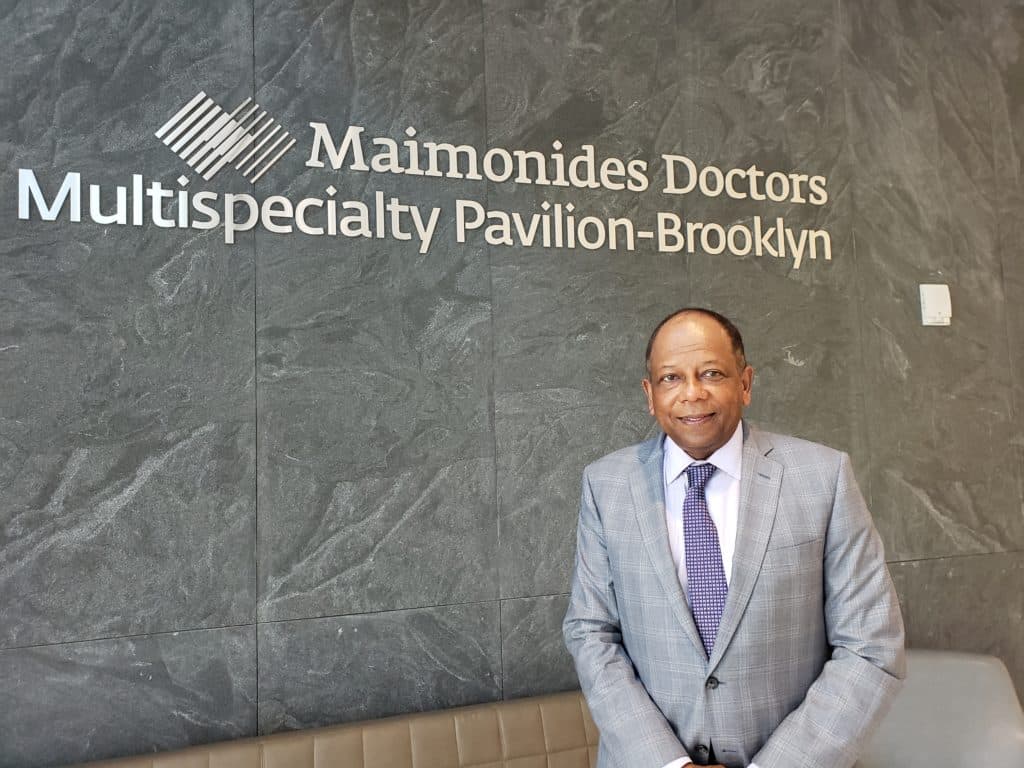
Anthony Kalloo, M.D.
Professor of Medicine, Johns Hopkins University School of Medicine; Chair, Department of Medicine, Maimonides Medical Center
Maimonides Medical Center
View specialist profileDr. Anthony Kalloo is a professor of medicine at Johns Hopkins and chairs the department of medicine at Maimonides Medical Center. He helped create the field of Natural Orifice Translumenal Endoscopic Surgery, the idea that an operation could be done through the stomach or colon with no external cuts 12. Decades earlier, he led a New England Journal of Medicine trial showing that a Botox injection into the lower esophageal sphincter could relieve achalasia 13, a rare swallowing disorder. He treats patients with complex swallowing, bile duct, and pancreatic problems.

Dr. Mouen Khashab directs therapeutic endoscopy at Johns Hopkins Hospital. He performs some of the most technically demanding procedures in the field, including EUS-guided biliary drainage when standard ERCP is not possible 16, gallbladder drainage in patients too sick for surgery 16, and gastric peroral endoscopic myotomy (G-POEM) for gastroparesis. His meta-analysis on G-POEM 20 helped move the procedure into mainstream practice for patients whose stomachs empty too slowly.

Dr. Eun Shin is an associate professor at Johns Hopkins who focuses on endoscopic evaluation of esophageal, stomach, and pancreatic conditions. She has worked on both the diagnostic side, using endoscopic ultrasound to find small pancreatic neuroendocrine tumors that CT scans miss 22, and the molecular side, including a 2012 comparative genomic study that first showed how different esophageal adenocarcinoma and squamous cell carcinoma are at the DNA level 21. Her recent work on neoadjuvant immunotherapy for esophageal cancer 25 reflects how quickly this field is changing.

Elham Afghani, M.D.
Associate Professor of Medicine, Johns Hopkins University School of Medicine
Johns Hopkins Hospital
View specialist profileDr. Elham Afghani is an associate professor of medicine at Johns Hopkins who focuses on pancreatic disease. She treats patients with acute and chronic pancreatitis, pancreatic cysts, and sphincter of Oddi dysfunction, and performs endoscopy aimed at diagnosing and treating these conditions. Her systematic review on post-ERCP pancreatitis 26 is the reference point most endoscopists use when counseling patients on the risks of that procedure, and her work on EUS-guided biliary drainage 27 helped validate the technique as an alternative when ERCP fails.
What to look for in a gastroenterologist
- Board certification in gastroenterology, plus fellowship training in advanced or therapeutic endoscopy if you need a complex procedure
- Affiliation with a teaching hospital that performs a high volume of the procedure you need
- Subspecialty focus that matches your condition (pancreatic disease, Barrett's esophagus, motility, inflammatory bowel disease)
- Honest answers about procedure volume, complication rates, and wait times
- Insurance compatibility and clarity about out-of-pocket cost
- A clear plan for follow-up after the procedure
Questions to ask before your first appointment
- How many of these procedures do you personally perform each year?
- What are the main risks and how often do they happen at your center?
- Is there a less invasive option I should consider first?
- If something goes wrong during the procedure, what is the backup plan?
- Will the same doctor who sees me in clinic be the one performing the procedure?
- How will we decide if the procedure worked, and what are the next steps if it does not?
The bottom line
Advanced endoscopy in Maryland is concentrated at Johns Hopkins and its affiliated hospitals, and the six doctors on this list cover most of the hardest cases in the state. If your local gastroenterologist is not sure how to handle your condition, or if you need a specific procedure like EUS-guided drainage, G-POEM, or pancreatic cancer screening, ask for a referral to one of these programs. A second opinion at a high-volume center is reasonable any time a complex or repeat procedure is on the table.
Sources
- 1.
- 2.Photodynamic therapy with porfimer sodium for ablation of high-grade dysplasia in Barrett's esophagus: international, partially blinded, randomized phase III trial — Gastrointestinal Endoscopy, 2005. DOI
- 3.Advances in counselling and surveillance of patients at risk for pancreatic cancer: Table 1 — Gut, 2007. DOI
- 4.Identification of hepatocarcinoma-intestine-pancreas/pancreatitis-associated protein I as a biomarker for pancreatic ductal adenocarcinoma by protein biochip technology. — PubMed, 2002.
- 5.
- 6.Flexible transgastric peritoneoscopy: a novel approach to diagnostic and therapeutic interventions in the peritoneal cavity — Gastrointestinal Endoscopy, 2004. DOI
- 7.
- 8.Comparison of Existing Clinical Scoring Systems to Predict Persistent Organ Failure in Patients With Acute Pancreatitis — Gastroenterology, 2012. DOI
- 9.
- 10.The effect of magnesium supplementation on blood pressure: a meta-analysis of randomized clinical trials — American Journal of Hypertension, 2002. DOI
- 11.
- 12.ASGE/SAGES Working Group on Natural Orifice Translumenal Endoscopic Surgery — Surgical Endoscopy, 2006. DOI
- 13.Intrasphincteric Botulinum Toxin for the Treatment of Achalasia — New England Journal of Medicine, 1995. DOI
- 14.Gastric peroral endoscopic myotomy for refractory gastroparesis: first human endoscopic pyloromyotomy (with video) — Gastrointestinal Endoscopy, 2013. DOI
- 15.
- 16.Endoscopic ultrasound-guided transmural stenting for gallbladder drainage in high-risk patients with acute cholecystitis: a systematic review and pooled analysis — Surgical Endoscopy, 2016. DOI
- 17.
- 18.Nonalcoholic fatty liver disease and cardiovascular risk — Current Gastroenterology Reports, 2009. DOI
- 19.Novel ex vivo model for hands-on teaching of and training in EUS-guided biliary drainage: creation of “Mumbai EUS” stereolithography/3D printing bile duct prototype (with videos) — Gastrointestinal Endoscopy, 2014. DOI
- 20.Efficacy and feasibility of G-POEM in management of patients with refractory gastroparesis: a systematic review and meta-analysis — Endoscopy International Open, 2019. DOI
- 21.Comparative Genomic Analysis of Esophageal Adenocarcinoma and Squamous Cell Carcinoma — Cancer Discovery, 2012. DOI
- 22.EUS is still superior to multidetector computerized tomography for detection of pancreatic neuroendocrine tumors — Gastrointestinal Endoscopy, 2010. DOI
- 23.Steroid Avoidance in Liver Transplantation: Meta-Analysis and Meta-Regression of Randomized Trials — Liver Transplantation, 2008. DOI
- 24.Tumor Size and Location Correlate With Behavior of Pancreatic Serous Cystic Neoplasms — The American Journal of Gastroenterology, 2011. DOI
- 25.Neoadjuvant nivolumab or nivolumab plus LAG-3 inhibitor relatlimab in resectable esophageal/gastroesophageal junction cancer: a phase Ib trial and ctDNA analyses — Nature Medicine, 2024. DOI
- 26.Incidence, severity, and mortality of post-ERCP pancreatitis: a systematic review by using randomized, controlled trials — Gastrointestinal Endoscopy, 2014. DOI
- 27.A Comparative Evaluation of EUS-Guided Biliary Drainage and Percutaneous Drainage in Patients with Distal Malignant Biliary Obstruction and Failed ERCP — Digestive Diseases and Sciences, 2014. DOI
- 28.Chronic Pancreatitis: Current Status and Challenges for Prevention and Treatment — Digestive Diseases and Sciences, 2017. DOI
- 29.
- 30.
Related specialist lists
gastroenterology
Gastroenterologists in New York to consider
Research-informed guide to gastroenterologists in New York, drawing on published work from physicians at NYU Langone, NewYork-Presbyterian, and Montefiore.
gastroenterology
Top gastroenterologists in Minnesota
Six of Minnesota's top gastroenterologists — covering IBD, motility, hepatology, fatty liver disease, and advanced endoscopy — by published research.
gastroenterology
Best Gastroenterologists for ERCP and Biliary Endoscopy in Kansas
Kansas gastroenterologists who specialize in ERCP and biliary endoscopy, with deep experience in bile duct stones, strictures, and pancreatic disease.