Expert list · Last reviewed April 17, 2026
Best Neurologists for Sleep Disorders in Ohio
Top Ohio neurologists treating sleep disorders, from sleep apnea to narcolepsy, with clinical focus, hospital affiliation, and published research.
Loading map…
Ohio has a concentrated group of neurologists who treat sleep disorders at a level that holds up against any program in the country, and several practice within an hour of Cleveland or Columbus.
If you are looking for the best neurologists for sleep disorders in Ohio, the practical question is which program matches your specific problem. Sleep apnea that has not responded to CPAP needs a different clinician than narcolepsy, and a child who snores through the night needs a different clinician than an adult whose epilepsy drugs have wrecked their sleep. The six physicians below practice at Cleveland Clinic, University Hospitals, and Ohio State Wexner — the three systems that run accredited sleep labs and keep the published literature moving forward.
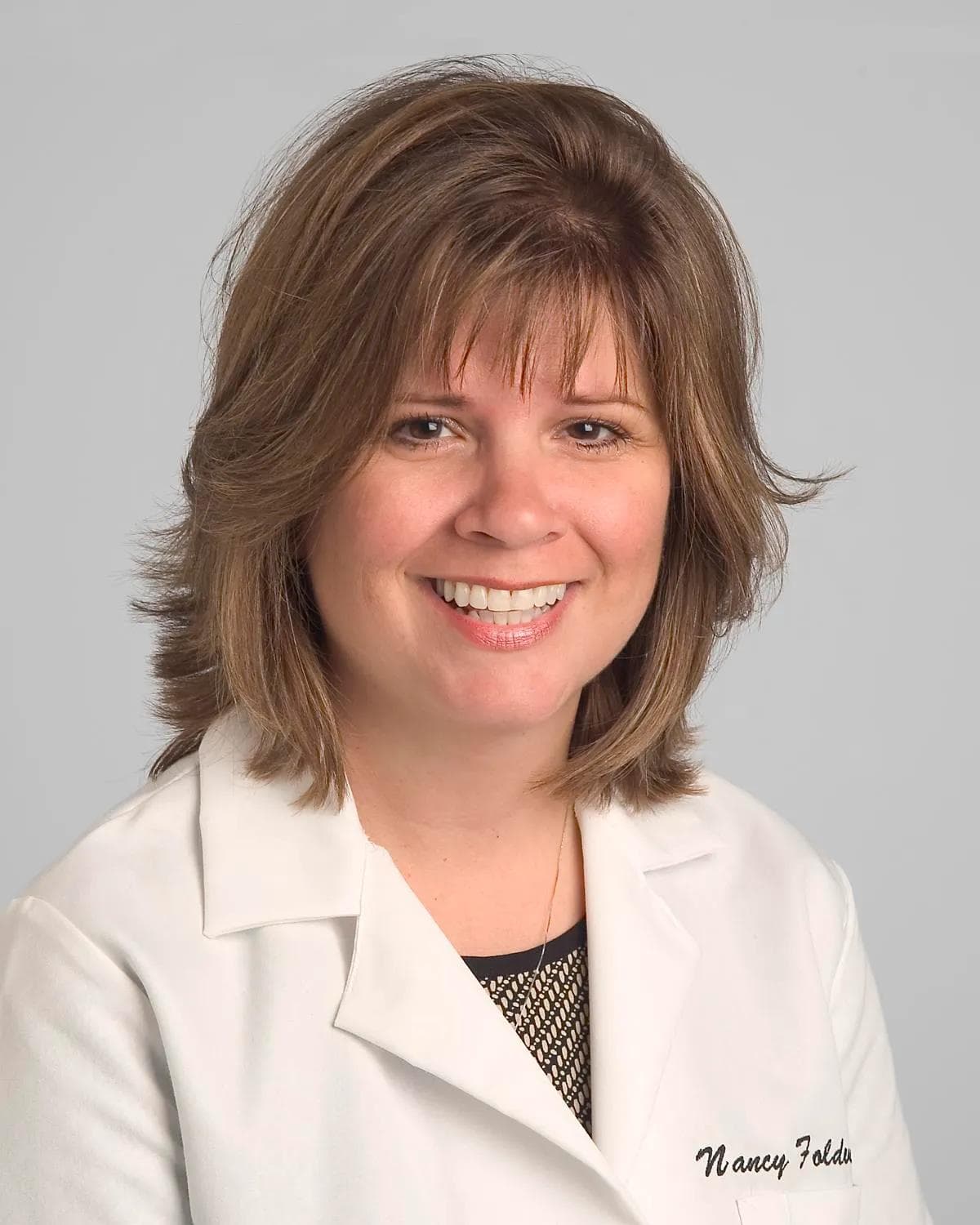
Nancy Foldvary-Schaefer, DO
Professor of Neurology and Staff in the Sleep Disorders and Epilepsy Centers
Cleveland Clinic
View specialist profileDr. Foldvary-Schaefer is a staff neurologist at Cleveland Clinic's Sleep Disorders and Epilepsy Centers and a professor of neurology. She sees adults whose sleep problems overlap with seizures, narcolepsy, or severe excessive daytime sleepiness, and she is one of the go-to referral destinations in the Midwest for patients who have been through multiple sleep studies without a clear answer. Her team helped run the HomePAP trial 2, the study that established home sleep testing as a reasonable alternative to a lab sleep study for many people with suspected sleep apnea. She also led a long-term trial of solriamfetol 3, a newer medication for daytime sleepiness in patients with narcolepsy or sleep apnea.

Dr. Khan practices at Ohio State University Wexner Medical Center's Dublin location. She focuses on the sleep disorders most likely to affect the heart and blood vessels — obstructive sleep apnea, chronic insomnia, and obesity hypoventilation syndrome (where low nighttime oxygen is caused by a combination of weight and weak breathing). Patients typically come to her after a primary care doctor, cardiologist, or stroke team raises a concern about untreated sleep apnea. Her reviews on how insomnia and sleep loss raise cardiovascular risk 67 are widely cited by the doctors who decide whether to refer patients for a sleep study.

Dr. Parikh sees patients at University Hospitals in Sheffield Village and at UH Geauga. He is the person to see when the upper airway itself is the problem — enlarged tonsils, chronic sinusitis, and other ear-nose-throat conditions that drive snoring, mouth-breathing, and pediatric sleep apnea. He contributed to the national tonsillectomy guidelines 1314 that pediatricians use when deciding whether a child's snoring and daytime fatigue warrant surgery, and to the consensus statements on chronic rhinosinusitis 111215 that shape how adults with stuffy noses and poor sleep get treated.

Dr. Vensel Rundo is a sleep neurologist at Cleveland Clinic with privileges at Hillcrest and Medina Hospitals. Her patient panel leans toward people with moderate to severe sleep apnea who could not tolerate a CPAP mask and need an alternative — typically hypoglossal nerve stimulation, a small implanted device that gently moves the tongue forward during sleep to keep the airway open. She wrote the modern reference chapter on polysomnography 16 and regularly publishes on how to manage patients after a hypoglossal nerve stimulator is placed 181920.

Dr. Neme is a Cleveland Clinic neurologist who also sees patients at Akron General. Her niche is adults whose epilepsy medication has left them too tired to function during the day, where the usual question is whether the drug, the seizures, or an undiagnosed sleep disorder is the real driver. Her study on lacosamide and daytime sleepiness 21 helped clarify which epilepsy drugs are friendlier to sleep — useful when a patient is already dealing with both conditions.

Dr. Mindel practices at Ohio State Wexner Medical Center. He treats patients whose neurological conditions and sleep problems overlap — epilepsy, autoimmune encephalitis (when the immune system attacks the brain), and unusual cases where an implanted vagus nerve stimulator disturbs sleep 26. He is part of the Ohio State group studying focused ultrasound as a less invasive option for people whose epilepsy has not responded to medication 24.
What to look for in a sleep neurologist
- Board certification in neurology plus subspecialty certification in sleep medicine
- Academic affiliation with a teaching hospital and an AASM-accredited sleep lab
- A subspecialty focus that matches your condition (sleep apnea, narcolepsy, restless legs, parasomnia, or sleep in epilepsy)
- Current wait time and whether they are accepting new patients
- Insurance compatibility, including which sleep lab and equipment vendors are covered under your plan
Questions to ask before your first appointment
- How many patients with my condition do you treat each year?
- Will I need a home sleep test, an in-lab overnight study, or both?
- If CPAP does not work for me, what alternatives do you use most often?
- How are follow-up visits handled — in person, by video, or through a sleep lab coordinator?
- Do you coordinate directly with my cardiologist, pulmonologist, or neurologist, or do I need to relay results?
- How long does it typically take to get a diagnosis and start treatment?
The bottom line
Use this list as a shortlist, not a ranking. The best sleep neurologist for you is the one whose focus lines up with your specific problem — CPAP intolerance, narcolepsy, pediatric airway issues, or sleep complications from epilepsy medication. If your primary care doctor or current neurologist has not been able to sort out why you are not sleeping, ask for a direct referral to one of these programs and bring any prior sleep study results with you to the first visit.
Sources
- 1.
- 2.A Multisite Randomized Trial of Portable Sleep Studies and Positive Airway Pressure Autotitration Versus Laboratory-Based Polysomnography for the Diagnosis and Treatment of Obstructive Sleep Apnea: The HomePAP Study — SLEEP, 2012. DOI
- 3.Long-term study of the safety and maintenance of efficacy of solriamfetol (JZP-110) in the treatment of excessive sleepiness in participants with narcolepsy or obstructive sleep apnea — SLEEP, 2019. DOI
- 4.
- 5.
- 6.The Effects of Insomnia and Sleep Loss on Cardiovascular Disease — Sleep Medicine Clinics, 2017. DOI
- 7.The Effects of Insomnia and Sleep Loss on Cardiovascular Disease — Sleep Medicine Clinics, 2022. DOI
- 8.
- 9.Cost Minimization Using an Artificial Neural Network Sleep Apnea Prediction Tool for Sleep Studies — Annals of the American Thoracic Society, 2014. DOI
- 10.
- 11.International Consensus Statement on Allergy and Rhinology: Rhinosinusitis — International Forum of Allergy & Rhinology, 2016. DOI
- 12.International consensus statement on allergy and rhinology: rhinosinusitis 2021 — International Forum of Allergy & Rhinology, 2020. DOI
- 13.
- 14.Clinical Practice Guideline: Tonsillectomy in Children (Update)—Executive Summary — Otolaryngology, 2019. DOI
- 15.
- 16.
- 17.
- 18.Comparison of clinical pathways for hypoglossal nerve stimulation management: in-laboratory titration polysomnography vs home-based efficacy sleep testing — Journal of Clinical Sleep Medicine, 2023. DOI
- 19.Comparison of Home Sleep Devices and Sleep Study Testing in Hypoglossal Nerve Stimulation Patients — The Laryngoscope, 2024. DOI
- 20.Personalized multimodal management for severe obstructive sleep apnea in a patient intolerant of positive airway pressure with hypoglossal nerve stimulator and mandibular advancement device — Journal of Clinical Sleep Medicine, 2022. DOI
- 21.Wake up to sleep: The effects of lacosamide on daytime sleepiness in adults with epilepsy — Epilepsy & Behavior, 2017. DOI
- 22.VNS Stopping Anti-NMDA Receptor Encephalitis–Triggered Nonconvulsive Status Epilepticus — World Neurosurgery, 2020. DOI
- 23.Orthostatic hypotension in the Holmes-Adie syndrome. — PubMed, 1980.
- 24.
- 25.
- 26.
Related specialist lists
neurology
Best Neurologists in New York
Six of New York's top neurologists — covering stroke, peripheral neuropathy, multiple sclerosis, epilepsy, and Parkinson's disease — selected by peer recognition and published research.
neurology
Best Neurologists in Ohio
Six of Ohio's top neurologists — covering epilepsy, multiple sclerosis, movement disorders, sleep neurology, and neuromuscular medicine — selected by research output and peer recognition.
neurology
Find a Neurologist in Illinois
Six practicing neurologists in Illinois covering epilepsy, multiple sclerosis, sleep, and cognitive neurology — with research records that shape how these conditions are treated.