Expert list · Last reviewed April 13, 2026
Top cardiac electrophysiologists in Virginia 2026
Five Virginia cardiac electrophysiologists selected by research output and clinical focus — covering atrial fibrillation, pacemakers, ICDs, and sudden cardiac death.
Loading map…
If you're looking for a cardiac electrophysiologist in Virginia, this guide covers five physicians whose research and clinical work span atrial fibrillation, pacemakers, implantable defibrillators, and sudden cardiac death prevention. These are the doctors you call when your heart beats too fast, too slow, or erratically, and when the answer might involve a catheter, a device, or both.
Virginia has EP programs across a range of settings — academic centers in Richmond and Northern Virginia, and community hospitals in Lynchburg. Each physician below has published research that informs current EP practice.
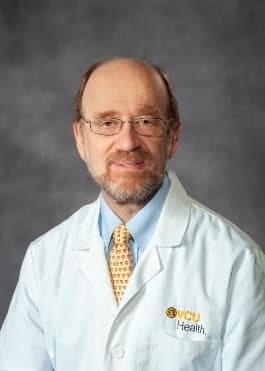
Kenneth Ellenbogen, MD
Kimmerling Professor of Cardiology; Director of Clinical Cardiac Electrophysiology and Pacing, Pauley Heart Center
VCU Health Pauley Heart Center, Richmond
View specialist profileKimmerling Professor of Cardiology and Director of Clinical Cardiac Electrophysiology and Pacing at the Pauley Heart Center, Dr. Ellenbogen sees patients at VCU Health in Richmond.
His work focuses on cardiac pacing and atrial fibrillation — two of the most common reasons patients end up in an EP practice — and his research output (over 1,100 publications, h-index 119) puts him among the most cited electrophysiologists working today.
A key contribution came from the MOST trial, which examined pacemaker programming in patients with sinus node dysfunction, the condition where the heart's natural pacemaker fires too slowly or unreliably. The study found that in patients with normal baseline QRS intervals, higher rates of ventricular pacing were tied to more heart failure hospitalizations and new atrial fibrillation, even when atrioventricular synchrony was preserved 3. That result reshaped how pacemaker programmers set rate-response and mode parameters.
He contributed to the ACC/AHA/ESC atrial fibrillation guidelines, which address how cardiologists decide between rate control, rhythm control, and anticoagulation in AF 1, and to the device-based therapy guidelines covering when to implant pacemakers and defibrillators across a range of arrhythmia diagnoses 2.

Dr. Arshad practices in Vienna, seeing patients at Inova Fairfax Hospital and Virginia Hospital Center, among other Northern Virginia sites.
Her clinical and research focus includes catheter ablation for atrial fibrillation and cardiac resynchronization therapy, a specialized pacemaker approach for people with both heart failure and electrical conduction problems.
Her first-author study in the Journal of the American College of Cardiology found that women responded significantly better to cardiac resynchronization therapy than men 5. CRT is a substantial intervention, and knowing who benefits most shapes patient selection — women with CRT-indicated heart failure now receive different counseling about expected outcomes, in part because of this work.
She has also studied pulmonary vein isolation, the catheter ablation technique used for AF. Her group tracked patients over the long term after successful ablation and found that late AF recurrence — appearing years after the procedure — was more likely in patients with hypertension and high cholesterol, and was usually tied to pulmonary vein reconnection rather than new trigger sites 6. This research clarified what "late recurrence" looks like mechanistically, which matters when patients ask what the real durability of ablation is.

Leonard Ilkhanoff, MD
Cardiac Electrophysiologist
Inova Fairfax Hospital, Gainesville
View specialist profileDr. Ilkhanoff trained at Northwestern University's Feinberg School of Medicine before joining Inova, where he practices at Inova Alexandria and Inova Fairfax hospitals in Gainesville.
His research interests center on arrhythmia risk markers — specifically, how findings on an ECG or in blood samples can predict who is at risk for dangerous heart rhythms before anything happens.
His work on early repolarization, an ECG pattern long considered benign, found that in patients with chronic coronary artery disease, early repolarization with notching in the inferior leads was tied to higher risk of life-threatening ventricular arrhythmias, even after accounting for ejection fraction 7. EP doctors and general cardiologists encounter this pattern regularly; this research informs when to treat it as a warning sign.
As first and corresponding author on a study using data from the Multi-Ethnic Study of Atherosclerosis (MESA), he found that prolonged QRS duration was associated with higher heart failure risk, and that the association tracked with underlying changes in left ventricular structure 9. Separately, his work in the ARIC study linked lower mitochondrial DNA copy number in blood to elevated sudden cardiac death risk in community populations 8 — a line of research exploring biomarkers that might one day flag at-risk patients before an event occurs.

Matthew Sackett, MD
Cardiac Electrophysiologist
Centra Lynchburg General Hospital, Lynchburg
View specialist profileDr. Sackett practices at Centra Lynchburg General Hospital in Lynchburg, serving patients in central Virginia.
His recent published work examined whether proactive esophageal cooling during pulmonary vein isolation ablation — a technique designed to protect the esophagus from thermal injury during AF ablation — also affects lab throughput. The study found that adopting the technique was associated with more procedures completed per day, even when fewer physicians were involved post-adoption 10. For patients, this suggests the protective measure does not come at the cost of longer procedure times.
He has also contributed to real-world data on AF ablation monitoring and complication tracking through multi-center registry work.

Omair Yousuf, M.D.
Cardiac Electrophysiologist
Inova Fairfax Hospital, Arlington
View specialist profileDr. Yousuf practices in Arlington and sees patients at Inova Fairfax Hospital, Novant Health Riverside Medical Center, and UVA Health Haymarket Medical Center in Northern Virginia.
His work spans cardiac electrophysiology, preventive cardiology, and device-based therapy. As first and corresponding author, he published a review in Circulation Research covering the clinical management and prevention of sudden cardiac death — from post-resuscitation care through ICD implantation, antiarrhythmic medications, and catheter ablation for ventricular tachycardia 12. Patients who have survived a cardiac arrest, or who have been told they're at high risk for one, will recognize the decision tree that review describes.
He has also published on high-sensitivity C-reactive protein as a cardiovascular risk marker, looking at how inflammation-based biomarkers fit into cardiac risk assessment more broadly 11 — relevant for patients being evaluated for both arrhythmia and underlying heart disease.
What a cardiac electrophysiologist treats
- Atrial fibrillation and atrial flutter
- Supraventricular tachycardia (SVT), including Wolff-Parkinson-White syndrome
- Ventricular tachycardia and ventricular fibrillation
- Heart block and bradycardia requiring pacemaker evaluation
- Syncope (fainting) caused by arrhythmia
- Inherited arrhythmia conditions, including long QT syndrome and Brugada syndrome
- Sudden cardiac death survival — evaluation and secondary prevention
- Device management: pacemakers, implantable cardioverter-defibrillators (ICDs), cardiac resynchronization therapy (CRT) devices
Questions to ask before your appointment
- What is causing my arrhythmia, and do you know how long I have had it?
- Do I need a monitor, an electrophysiology study, or imaging before you can recommend treatment?
- What are the options — medication, ablation, or a device — and what does the evidence say about each for my situation?
- If catheter ablation is recommended, how many procedures have you performed, and what is your success rate for my specific arrhythmia?
- What are the realistic risks of the procedure versus leaving the arrhythmia untreated?
- How will I be monitored after treatment, and how long does follow-up typically last?
- Should I be evaluated for an underlying heart condition that might be causing the rhythm problem?
The bottom line
Virginia's EP specialists are spread across the state — VCU's academic program in Richmond, the Inova network in Northern Virginia, and community programs like Centra in Lynchburg. If you're dealing with an arrhythmia that hasn't been explained or a device question that hasn't been resolved, any of the physicians here are worth reaching out to. Research depth varies, but each has a published record in EP and sees these conditions as their primary focus.
Sources
- 1.ACC/AHA/ESC 2006 Guidelines for the Management of Patients With Atrial Fibrillation — Circulation, 2006. DOI
- 2.ACC/AHA/HRS 2008 Guidelines for Device-Based Therapy of Cardiac Rhythm Abnormalities — Journal of the American College of Cardiology, 2008. DOI
- 3.Adverse Effect of Ventricular Pacing on Heart Failure and Atrial Fibrillation Among Patients With Normal Baseline QRS Duration in a Clinical Trial of Pacemaker Therapy for Sinus Node Dysfunction — Circulation, 2003. DOI
- 4.2011 ACCF/AHA/HRS Focused Update on the Management of Patients With Atrial Fibrillation (Updating the 2006 Guideline) — Circulation, 2010. DOI
- 5.Cardiac Resynchronization Therapy Is More Effective in Women Than in Men — Journal of the American College of Cardiology, 2011. DOI
- 6.Long‐Term Outcome Following Successful Pulmonary Vein Isolation: Pattern and Prediction of Very Late Recurrence — Journal of Cardiovascular Electrophysiology, 2008. DOI
- 7.Early Repolarization Associated With Ventricular Arrhythmias in Patients With Chronic Coronary Artery Disease — Circulation Arrhythmia and Electrophysiology, 2010. DOI
- 8.Association between mitochondrial DNA copy number and sudden cardiac death: findings from the Atherosclerosis Risk in Communities study (ARIC) — European Heart Journal, 2017. DOI
- 9.Association of QRS Duration with Left Ventricular Structure and Function and Risk of Heart Failure in Middle-Aged and Older Adults: The Multi-Ethnic Study of Atherosclerosis (MESA) — European Journal of Heart Failure, 2012. DOI
- 10.Association between proactive esophageal cooling and increased lab throughput — Journal of Cardiovascular Electrophysiology, 2024. DOI
- 11.High-Sensitivity C-Reactive Protein and Cardiovascular Disease — Journal of the American College of Cardiology, 2013. DOI
- 12.
Related specialist lists
cardiology / electrophysiology
Best Cardiac EP Specialists in California
Six of California's top cardiac electrophysiologists at UCLA, UCSF, and Stanford — selected by research output, peer recognition, and clinical credentials.
cardiology / electrophysiology
Top Cardiac Electrophysiologists in New York
Six New York cardiac electrophysiologists specializing in AFib ablation, ventricular arrhythmias, pulsed field ablation, and left atrial appendage closure.
cardiology
Top Cardiologists in New York 2026
New York's top cardiologists ranked by research output, peer recognition, and subspecialty expertise — covering TAVR, interventional cardiology, and cardiovascular risk.